Poppy Playtime Chapter 4 — Player Mindset & Calm Discipline (Stop Dying)
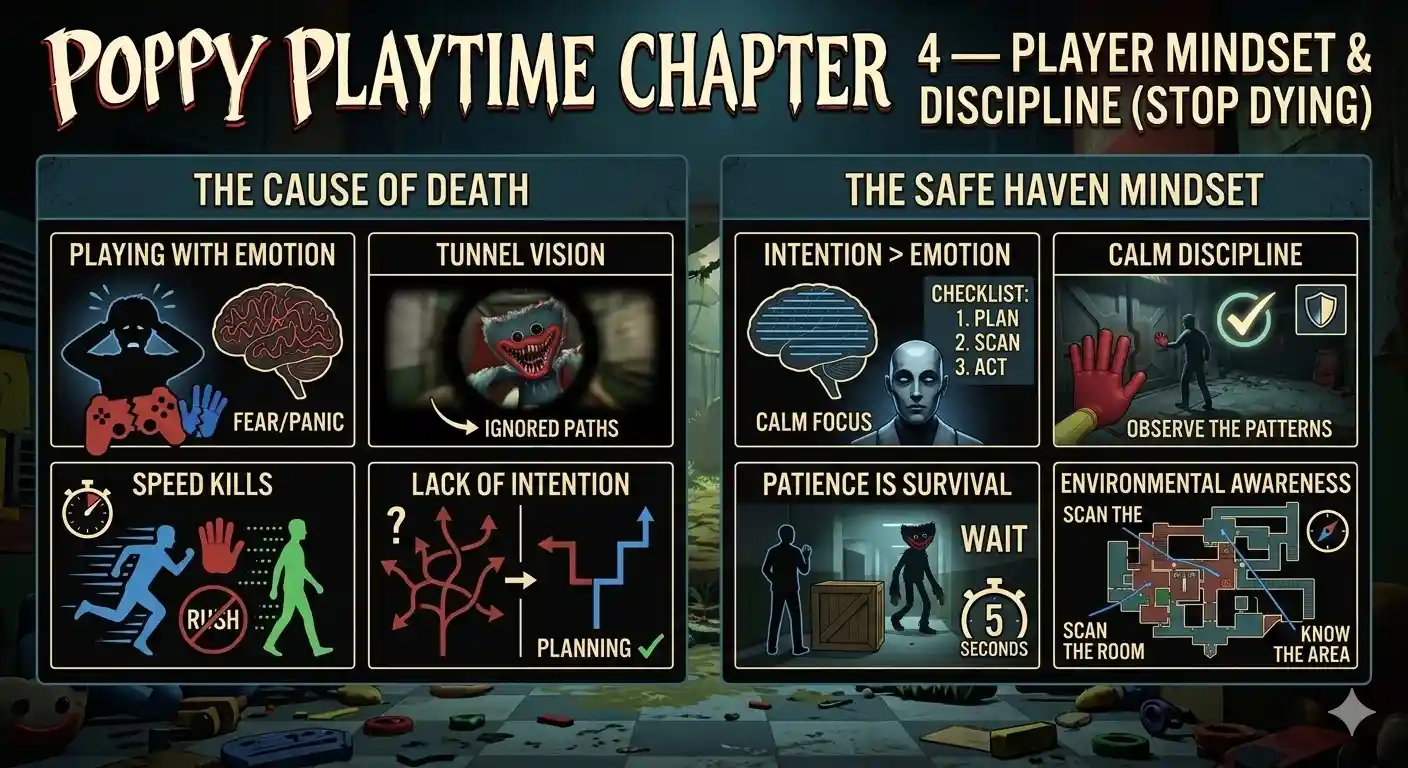
Most players die in Safe Haven for one reason:
They play with emotion instead of intention.
Chapter 4 doesn’t punish weakness.
It punishes speed, panic, and tunnel vision.
You are not competing against enemies —
you are competing against your own nervous system.
Survival begins before you move.
1. Fear Is Code — The Level Reads Your Behavior
Safe Haven doesn’t respond to what you see;
it responds to how you react.
- Sprinting = noise
- Noise = attention
- Attention = threat vectors
You think “run = survive.”
The bunker thinks “run = reveal yourself.”
You are playing chess with the facility, not dodgeball with monsters.
2. Break the Instinct: Speed Is Not Progress
Rushing is how amateurs die.
Fast movement:
- burns audio invisibility
- converts shadows into traps
- exposes you in long corridors
- eliminates reaction windows
Every time you sprint, you say:
“I’m scared. Please detect me.”
Veterans move slowly because they want control, not speed.
3. Your First Enemy Is The Camera
Panicking makes players look sideways or down.
You lose:
- map awareness
- sightlines
- exit planning
- backstep space
The correct stance:
- camera slightly elevated
- vertical awareness
- 60–80° field
- never stare at your feet
Your eyes are a weapon.
Don’t point them at the floor.
4. Discipline the Heart Rate
Safe Haven weaponizes adrenaline.
Panic feels like danger →
so you move faster →
so you create danger →
so you panic more.
That feedback loop kills 90% of players.
Break it:
- Stop moving for 2–3 seconds after stress
- Slice the map into short safe steps
- Breathe before turning corners
This is not fear control.
It’s performance control.
5. The 10–10 Rule — Movement Without Noise
Elite players use this method instinctively:
Move 10 meters → Stand 10 seconds
Why?
- Sound levels settle
- Ambient noise returns
- Your brain resets
- Enemies stop reacting
You are teaching the facility you are unpredictable.
Predictability = death.
6. Never Be the Aggressor
Chapter 4 punishes players who “go after danger.”
This isn’t a shooter.
This isn’t a chase game.
You don’t “hunt threats.”
You avoid feeding them triggers.
Every footstep, every sprint, every pivot says:
“I am here.”
The best players let the map breathe first.
7. Do Not Trust Open Routes
Amateurs love wide rooms.
Wide rooms are the graveyard.
Big spaces kill:
- Position
- Cover
- Escape logic
- Audio strategy
You can’t hide in volume.
You hide in structure.
Walls, cabinets, blind corners, low railings —
those are tools, not obstacles.
8. Take Corners Like a Surgeon
Players who hug walls are the ones who get erased.
Corner discipline:
Enter diagonally
Never at 90°
Never at full height
Never without a second exit
You don’t “peek to look.”
You “peek to predict.”
If the corner feels quiet, you are already in danger.
9. Accept That Fear Is Not a Signal
Your brain is primitive:
- dark = threat
- noise = danger
- silence = safe
Chapter 4 is built to weaponize these instincts.
Silence isn’t safety.
Sudden sound isn’t danger.
The environment is lying to you.
You must detach emotion from movement:
- If scared → slow down
- If unsure → stop
- If overwhelmed → wait
Survival is math, not courage.
10. Win by Boring the Game
This is how skilled players look “lucky”:
They make no mistakes because they refuse to play fast.
Slow players:
- see the patterns
- preserve reaction windows
- know where to backtrack
- understand sound triggers
Safe Haven wants you to be chaotic.
When you become boring,
you become untouchable.
Final Rule
A calm player is invisible.
Rage, rushing, panic —
these are flares in the dark.
If you walk, observe, breathe,
and move deliberately:
Safe Haven cannot kill you.
You kill yourself.