Poppy Playtime Chapter 4 Design Philosophy — Why Safe Haven Punishes Speedrunners
Chapter 4 isn’t built like a horror game.
Safe Haven is an anti-speedrun environment — every hallway, switch, and corner exists to humiliate players who try to brute-force progress.
Not because the developers hate skill.
Because speedrunning removes uncertainty — the one ingredient horror cannot survive.
Speedrunners Treat Horror Like a Racing Track
Speedrunners strip horror games to:
- fastest routes
- safest loops
- predictable chase triggers
- optimized puzzle orders
- movement tech
They turn fear into math.
Safe Haven does the opposite:
- punishes repetition
- kills linear routes
- weaponizes hesitation
- forces sensory listening
- denies predictable patterns
It’s a psychological ambush against “optimization players.”
The Core Design Principle — Don’t Reward Momentum
Horror games normally reward momentum:
- “You solved it? Go!”
- “You escaped? Next area!”
- “You outran them? Good job!”
Chapter 4 breaks this rule.
Safe Haven’s philosophy:
Movement without awareness is suicide.
Speedrunners rely on:
- long sprints
- known cut-throughs
- memorized layouts
Safe Haven removes the one thing they need: distance.
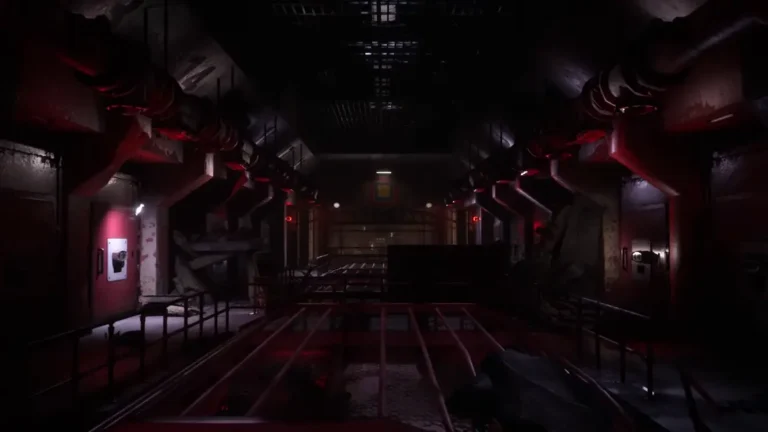
Narrow Rooms > Long Hallways
Maps designed for speed have:
- straight corridors
- safe exits
- long uninterrupted runs
Safe Haven weaponizes confinement:
- blind corners
- looping choke points
- industrial dead zones
You don’t “flow” through the level.
You negotiate every meter.
This destroys routing confidence.
Sound Is a Mechanic, Not Decoration
Speedrunners turn sound off.
They play to pure input.
Safe Haven forces sound awareness:
- machinery shifts
- echo placement
- air pressure hum
- floor strain
- distant activity
You don’t listen because it’s atmospheric.
You listen because it’s predictive.
Players who rush ignore audio.
Safe Haven hunts them.
Enemy Logic Is Built Against Habit
Speedrunning relies on pattern recognition:
- “If I run here, the enemy will chase.”
- “If I break line here, I reset.”
- “If I bait here, I loop.”
Chapter 4 flips it:
Enemies don’t care about the route.
They care about your behavior.
Movement patterns, tool usage, sprint frequency —
not the path.
The game adapts to player rhythm, not level geometry.
Speedrunner mistake:
“I’ll do the same trick that worked in Chapter 3.”
Safe Haven answer:
“Do it twice and you die.”
Puzzle Solving Requires Stillness
Speedrunners hate stillness.
Stillness is wasted time.
Chapter 4 punishes puzzle rushing:
- delayed activation
- punishable mid-solve exposure
- multi-step traces
- forced retreat positions
You can’t solve puzzles while:
- sprinting,
- breathing hard,
- panicking.
You must control the environment first.
Speedrunning brain doesn’t accept this.
It dies.
The Omni-Hand Is Not a Speed Tool
Speedrunners view tools as:
- movement accelerators
- shortcut triggers
- interaction skips
Chapter 4 reframes the tool:
- electrical bridge
- risk amplifier
- line-of-sight beacon
Use Omni-Hand while exposed → punishment.
Charge mid-chase → punishment.
Chain nodes too fast → punishment.
The Omni-Hand tests discipline, not reflex.
Level Architecture Breaks Route Dependency
Speedrunning thrives on:
- memorization
- repetition
- mechanical efficiency
Chapter 4 destroys:
- straight lines
- open fields
- predictable loops
Instead it gives:
- segmented spaces
- multi-tier rooms
- micro-arenas
- choke grids
- angle traps
The building is not a race course.
It is a cage with rules you must respect.
Speed Is Not Power — Silence Is
This is the philosophical knife of Safe Haven:
Quiet players win. Loud players die.
Speed = noise
Noise = visibility
Visibility = vulnerability
Every time you sprint,
you broadcast:
- your direction
- your state
- your panic
Speedrunners weaponize speed.
Safe Haven weaponizes your noise.
Skill Is Redefined
In traditional games:
Speed = mastery
In Safe Haven:
Patience = mastery
Speedrunners try to win with mechanics.
Safe Haven forces them to win with psychology.
True mastery is:
- listening
- risk weighting
- environment reading
- path shaping
- tool restraint
Not movement sequences.
The Hidden Design Goal
The game wants you to stop thinking:
“How fast can I beat this?”
And start thinking:
“How quietly can I survive this?”
That shift is why Safe Haven is memorable.
You don’t speedrun through it.
You grow through it.
Final Word
Speedrunners believe:
- the game is a problem
- movement is the solution
Chapter 4 believes:
- the world is hostile
- awareness is survival
You don’t dominate Safe Haven by outrunning it.
You dominate it by outthinking it.