Poppy Playtime Chapter 4 Omni-Hand Mastery — Electrical, Timing, Traps & Pro Techniques
The Omni-Hand is not a “tool.” It is the most dangerous mechanic in Safe Haven — for the player. Used wrong, it will get you killed 10 times in the same hallway. Used properly, it makes the environment your personal shield.
This guide teaches theory and discipline, not buttons.
Mastering the Omni-Hand in Poppy Playtime Chapter 4 requires understanding geometry, timing, and psychological pressure — not just button inputs. This guide covers the core principles of safe charging, the three most common death patterns, advanced four-pattern techniques, and the mental model that separates survival from repeated deaths in Safe Haven.
Core Principle — Charge Only When You Control the Room
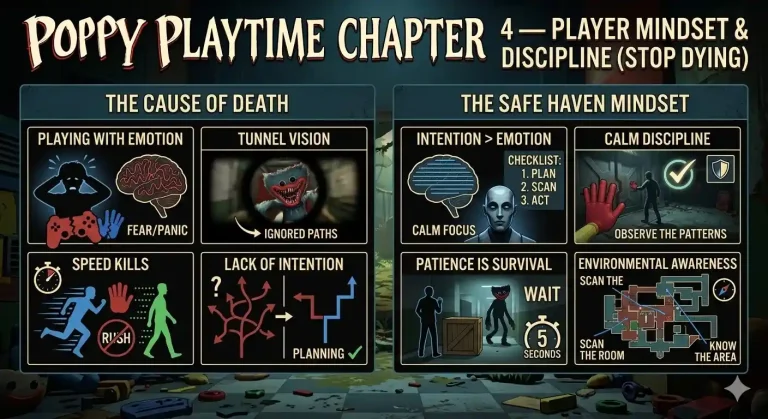
Beginners and experienced players use the Omni-Hand in fundamentally different mental states. The difference is not reflexes or game knowledge — it’s framing.
Beginners think: “I interact → I charge → I solve.”
Professionals think: “I neutralize → I position → I execute.”
Charging is a declaration of vulnerability. The Omni-Hand immobilizes your brain and your awareness. You are never “solving a puzzle.” You are broadcasting location and intent to everything in the room.
Understanding movement theory in Chapter 4 is the foundation this principle builds on — positioning before the charge is what separates consistent survival from repeated deaths.
Omni-Hand as Electrical System, Not Weapon
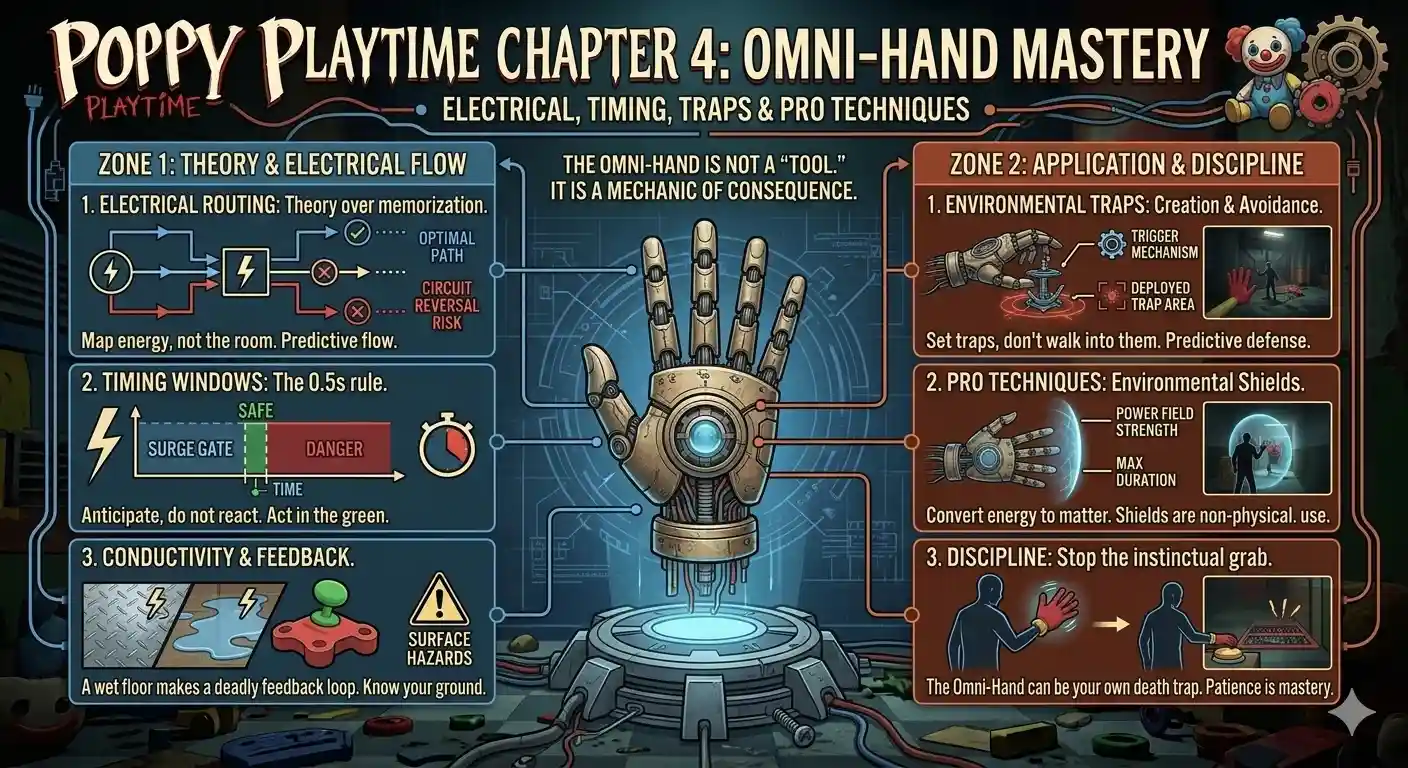
The Omni-Hand isn’t a “key.” It is an electrical bridge. You are not “activating a device.” You are closing a circuit between two hostile endpoints.
Electrical design fundamentals:
- Source → Path → Destination
- Line-of-sight does not equal safety
- Conduction is exposure
If the path is exposed, you are exposed.
The Three Deadliest Omni-Hand Errors
- Charging in the open — You freeze, you glow, you die.
- Connecting while sprinting — Your brain stops thinking and you mechanically press.
- Holding charge in long corridors — You turn the environment into a straight-line kill zone.
Every one of those deaths feels unfair. They are not. They are physics and psychology interacting with your panic. Understanding the enemies and their counter patterns makes these errors much easier to avoid.
The Real Use Case — Electrical Geometry
The Omni-Hand interacts with panel height, corner depth, terminal angle, and floor and wall offsets. You don’t “look at a node.” You read the geometry around it.
Correct process:
- Scan angles
- Measure blind spots
- Identify cover
- THEN connect
If a terminal is perfectly visible from your position, ask one question first: “Visible to who?” A terminal you can see clearly is a terminal that announces your presence equally clearly.
Omni-Hand Timing — The Kill Window
When you charge the Omni-Hand, three things happen simultaneously inside your own cognition:
- Your tunnel vision increases
- Your auditory awareness collapses
- Your sprint decision is delayed
That window is when you die.
Pros do this:
- Charge after line-of-sight break
- Release before sound resets
- Move only when circuit is stable
Charging is not an action — it’s a state you must survive through.
The Trap Environments
Safe Haven intentionally places Omni-Hand puzzles inside environments engineered to exploit your psychology.
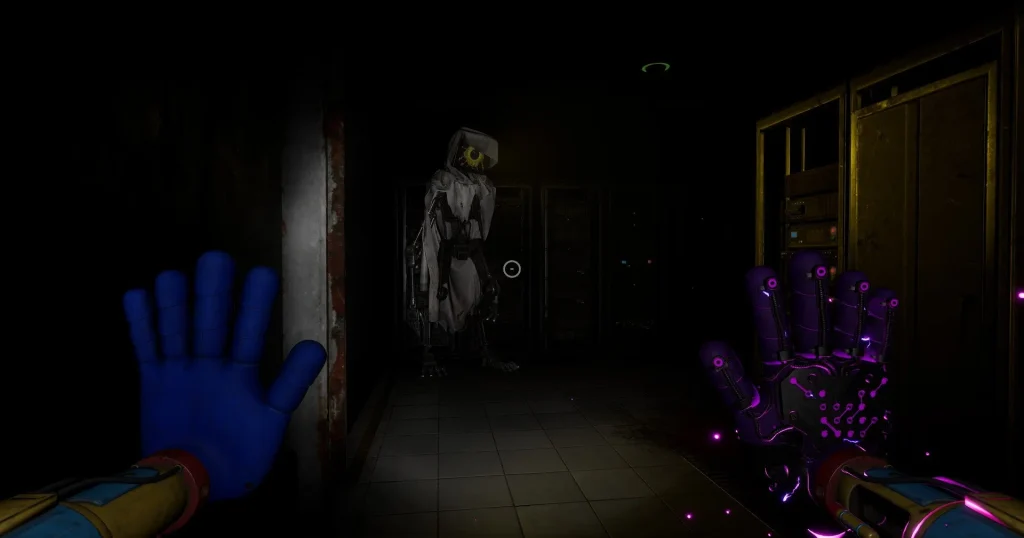
- Wide pit-like rooms
- Echo chambers
- Long-view corridors
- Pressure-sounding industrial halls
Omni-Hand placed inside an exposed environment causes your brain to abandon survival instincts for progress instincts. That is the trap. You become prey the moment you prioritize the puzzle over your position.
Pro Technique — “Two-Stage Solve”
The most consistent Omni-Hand technique in the game. It forces you to separate understanding from execution — which eliminates panic decisions.
Stage 1: Understand
- Walk the room fully
- Identify cover zones
- Find reset angles
- Locate secondary terminals
Stage 2: Execute
- Connect
- Retreat 2–3 steps diagonally
- Check audio
- Continue
You solve the puzzle in bursts, not in one heroic moment.
This technique pairs directly with the Chapter 4 puzzle walkthrough — use that resource to pre-learn puzzle layouts before applying the Two-Stage Solve in practice.
Corner Solving vs. Corridor Solving
Where you stand when you solve determines whether you live or die. The same puzzle has completely different death probability depending on your angle of approach.
- Open line of sight
- No lateral safety
- Hard reaction time
- High death probability
- Instant angle break
- Reduced noise cone
- Easy retreat path
- Low death probability
If the puzzle is visible from 30 meters away, you should not be solving it yet.
Omni-Hand Is a Stealth Tool
It is the anti-sprint weapon. Most players treat the Omni-Hand as a puzzle mechanic. Elite players treat it as a movement tool operated under stealth conditions.
- Panic loop
- Loss of audio awareness
- Telegraphed position
- Control loop
- Full audio awareness
- Quiet movement
You use Omni-Hand to move gently through danger, not to smash through it. Quiet = invisible. Fast = hunted.
Advanced Patterns
These are the patterns elite players use consistently across Safe Haven’s hardest Omni-Hand sections.
- Charge behind cover
- Establish connection
- Fade backward 3–4 steps
- Watch environment
You do not “finish” at the node. You complete at safety.
- Begin a connection
- Progress puzzle 30–50%
- Retreat fully
- Re-enter from a new angle
AI loses rhythm. Environment loses prediction. You regain control.
Never move in straight lines. Run diagonally, connect diagonally, retreat diagonally. Straight lines are predictable. Angles create chaos in AI pathing.
- If pressure is heard — let go
- Walk, crouch, or slow down completely
- Return after 5–8 seconds
You do not try again immediately. You erase yourself from the environment first.
When to NEVER Use Omni-Hand
These environments are designed to kill you the moment you charge. If you find yourself in any of these conditions — do not connect.
- Long corridors with no cover breaks
- Rooms with central floor lighting
- Mechanical echo chambers
- Any space where you can be seen from 3 or more angles simultaneously
- Places with elevation positioned behind you
- Areas with unscanned vents or side paths
If you do not fully understand the room, you do not use the Omni-Hand inside it. Scan first. Always.
The Mental Model
Think of Omni-Hand not as “Solve the puzzle” but as a different question entirely:
“When I charge, I am prey.”
This is the single biggest mindset difference between dying constantly and moving through Safe Haven like a surgeon. Every decision before the charge — positioning, audio check, angle selection — is what determines survival, not the charge itself.
For a deeper look at how Safe Haven’s design intentionally manufactures this psychological pressure, read our Chapter 4 design philosophy and speedrunner punishment analysis.
Final Law of Omni-Hand Mastery
You do not beat Safe Haven with speed. You beat it with silence, geometry, and respect.
If you stop thinking “tool in my hand” and start thinking “I’m completing a circuit inside a living machine,” the entire campaign changes.
Once you internalize the electrical model — source, path, destination, exposure — every room in Safe Haven becomes readable. Not easy. Readable. And readable is survivable.
When Safe Haven is done, see our Chapter 4 ending explained for a full breakdown of what the final events actually mean inside the larger Poppy Playtime story.