
If you run straight down a corridor, you’re already dead.
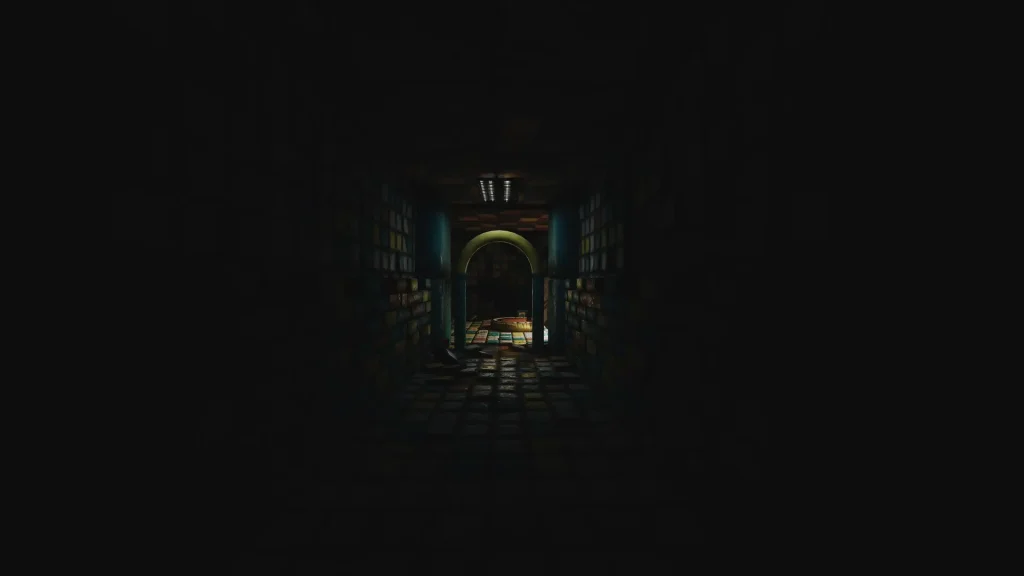
Corridors in Safe Haven are designed to collect noise, compress sightlines, and remove exits.
Think of every straight hallway as:
“A gun barrel you voluntarily stepped into.”
Correct behavior:
- Short walk
- Corner check
- Angle break
- Continue
You only sprint in corridors if there is already a threat, not because you’re impatient.
Corners Are Your Shield, Not Obstacles
Low-skill players fear corners.
High-skill players hunt them.
Corners:
- break line-of-sight instantly
- reset sound direction
- erase prediction models
- give you time to breathe
Every corner is a manual save point.
You use it before rotating, not after.
Doors Are Not Progress — They’re Resets

Most players use doors like checkpoints:
“Go through → run → hope.”
You use doors as line-of-sight erasers.
Pro technique:
- Pass threshold
- Turn diagonal
- Stop, not sprint
- Decide
This kills pursuit memory.
You don’t slam doors.
You control them.
Movement Has Three Modes
Mode 1: Exploration (silent)
- walk
- crouch adjusts
- angled body positioning
- Omni-Hand off
Used when:
- no known threat
- puzzle scouting
- first-time areas
You’re gathering data, not progressing.
Mode 2: Execution (focused)
- short bursts of movement
- corner utilization
- optimized routes
- Omni-Hand only when hidden
Used when:
- solving puzzles
- interacting with terminals
- repositioning to new zones
Never sprint during execution unless corner resetting.
Mode 3: Survival (controlled panic)
- sprint 2–3 seconds max
- break vision
- change elevation or direction
- go silent
Used when:
- detected
- audio threat present
- no cover nearby
Most players die because they jump from Mode 1 → Mode 3 with nothing in between.
Noise Is More Dangerous Than Speed
Speed does not kill you.
Noise does.
Every sound you make does one thing:
It gives the environment a location anchor.
Sprint = loud
Door slam = loud
Charging Omni-Hand = loud
Landing = loud
Pro movement is quiet movement.
If you can hear yourself breathing hard?
You’re already exposed.
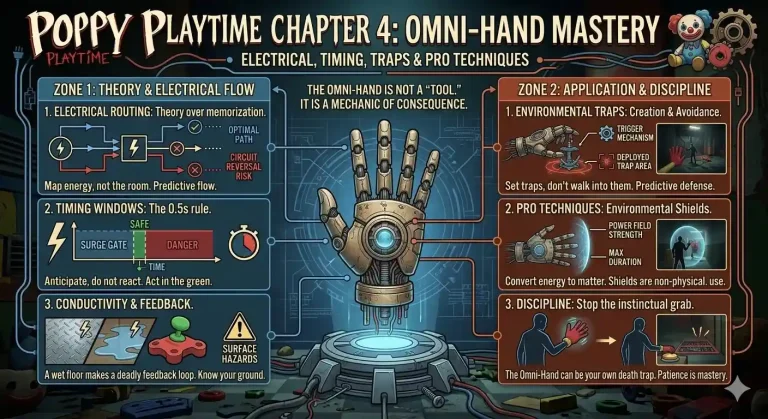
The Omni-Hand Is Not “Go Faster”
The Omni-Hand is a signal flare.
You do not use it to move efficiently.
You use it to cross dangerous spaces quietly and finish tasks behind cover.
Golden rule:
Omni-Hand is used when unseen, not when chased.
Charging in the open is suicide.
Think:
- machine operator
- electrician
- maintenance worker
Not “player with a tool.”
Elevation Beats Distance
Running far is useless.
Breaking line-of-sight above or below is lethal to threats.
Safe move order:
- Sprint 1–2 seconds
- Turn
- Change elevation
- Silence
You don’t outrun danger.
You confuse it.
Movement Reset Patterns (Pro Tools)
These win in Safe Haven:
The Corner Drop
Sprint → turn → full silence → walk away.
Resets audio & prediction instantly.
The Axis Shift
90° direction change mid-pursuit.
AI expects your line.
You abandon it.
The Split Move
Interact → break angle → finish later.
You’re never exposed for more than 3–4 seconds.
The Ghost Walk
Walk → crouch → walk → interact → walk
No sprint, no panic, no broadcast.
The Only Players Who Die Consistently
1. Corridor addicts
They treat every hallway like a finish line.
2. Puzzle runners
They start solving while visible.
3. Sprint junkies
Their thumb is glued to the sprint button.
4. Tool spammers
They charge Omni-Hand in open space.
5. Loop repeaters
They assume old routes work forever.
They don’t.
Safe Haven punishes habit.
Pro Mindset
You are not being chased randomly.
You are being observed.
Movement is not:
- speed,
- reaction,
- or muscle memory.
It is:
- angle discipline
- audio discipline
- environment literacy
- restraint
You don’t run through Safe Haven.
You negotiate it.
Final Rule
If you move like prey, Safe Haven hunts you.
If you move like a technician, Safe Haven lets you pass.
That’s the entire philosophy.
Read More:
- Chapter 4 Enemies & Counters
- Puzzle Walkthrough (Strategy)
- Ending Explanation
- Design Philosophy (Anti-Speedrun)
Poppy Playtime Chapter 4 Movement Theory — How to Move Like a Pro Without Dying
Most players in Chapter 4 die because they treat movement like sprinting in an action game.
Safe Haven is not about how fast you move, but how invisible your movement feels to the environment.
This is the difference between dying ten times in the same hallway and walking through the entire map untouched.
Movement Is a Language, Not a Reaction
In Safe Haven, every input says something:
- Sprint → “I’m exposed.”
- Charge → “I’m locked in.”
- Stop → “I’m evaluating.”
- Angle break → “Find me.”
Players who die repeatedly speak only one sentence:
“I’m scared so I run.”
Pros speak:
“I move only when the environment lets me.”
Corridors Are Not Roads — They Are Traps